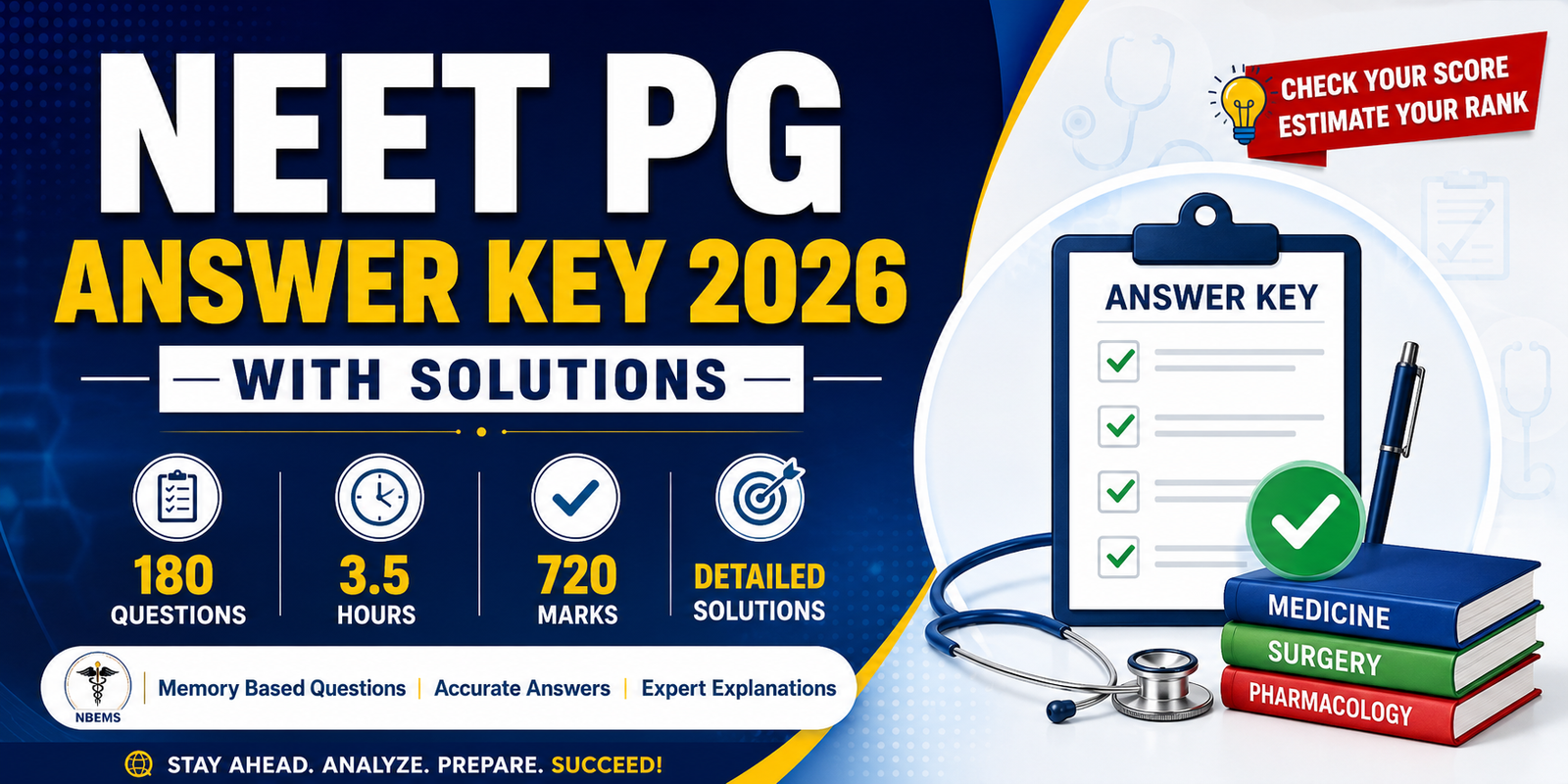
The NEET PG Answer Key 2026 is available for session 1. NEET PG Answer Key 2026 is provided for Session 1 Question Papers with correct answers and explanation.
The NEET PG Answer Key 2026 is a significant document for candidates who appeared in the National Eligibility cum Entrance Test and are interested in the medical admission to Postgraduate courses. Students may verify their answers by referring to the answer key, and gauge their chances of getting the correct answers and expected performance before the official result and scorecard is released.
The question paper given below is a memory based NEET PG 2026 question paper from the following subjects: Pediatrics, Microbiology, Biochemistry, Pharmacology, Anesthesia, Ophthalmology, Dermatology, Medicine, Psychiatry, Surgery, Orthopedics and Nephrology. The paper that was uploaded says that the exam is worth 720 marks, there are 180 compulsory questions and the marking is +4 for a correct answer and -1 for an incorrect answer.
Get Free Admission Guidance — Talk to an Expert Today
- Expert Guidance for Admission
- Step-by-step Counselling Support
Important: This is an answer key based on the questions from the memory based paper uploaded. It is not the official NBEMS answer key.
NEET PG 2026 Answer Key – Quick Overview
| Question | Correct Answer | Answer |
|---|---|---|
| 1 | (C) | Rubella virus |
| 2 | (C) | Regan isoenzyme |
| 3 | (D) | Decreased pulmonary vascular resistance |
| 4 | (B) | Hydroquinone |
| 5 | (C) | Stimulation of soluble guanylate cyclase |
| 6 | (C) | Remifentanil |
| 7 | (C) | Patient refusal |
| 8 | (B) | Active cortical suppression |
| 9 | (B) | Guttate psoriasis |
| 10 | (C) | Erythema multiforme |
| 11 | (A) | Alvimopan |
| 12 | (B) | Dengue fever |
| 13 | (B) | Eculizumab |
| 14 | (B) | Jeryl Lynn strain |
| 15 | (C) | Erythema migrans |
| 16 | (C) | Schizotypal personality disorder |
| 17 | (A) | Bipolar diathermy |
| 18 | (A) | Fibroadenoma |
| 19 | (B) | Aspermia |
| 20 | (C) | Post-streptococcal glomerulonephritis |
NEET PG 2026 Questions with Answers
Here are the NEET PG 2026 Questions with answers. These are the NEET PG 2026 Questions with correct answers.
Question 1: Congenital Infection
A newborn has hepatosplenomegaly, chorioretinitis, sensorineural deafness, with several bluish-purple skin lesions, which appear to be “blueberry muffin” lesions. Which organism is most likely to cause?
Get Free Admission Guidance — Talk to an Expert Today
- Expert Guidance for Admission
- Step-by-step Counselling Support
Answer: (C) Rubella virus.
Classically, congenital rubella syndrome consists of sensorineural deafness, congenital heart disease, and cataracts. Dermal extramedullary hematopoiesis may result in a “blueberry muffin” rash. Of the choices given, rubella virus is the most correct answer to the combination of characteristics described.
The question and options are given as per the memory based paper of NEET PG 2026 which is uploaded.
Get Free Admission Guidance — Talk to an Expert Today
- Expert Guidance for Admission
- Step-by-step Counselling Support
What is the significance of ALP Isoenzyme in Malignancy?
The serum alkaline phosphatase level is elevated in a patient with bronchogenic carcinoma. Which ALP isoenzyme is always elevated in malignancy especially in lung carcinoma?
Correct Answer: (C) Regan isoenzyme
Explanation: Regan is a placental type isoenzyme of alkaline phosphatase which can be formed by malignant cells. It is linked to some types of cancer such as lung cancer.
Placental, intestinal, Regan and bone isoenzymes are listed on the paper.
Which of the following increases pulmonary blood flow?
Which of the following would increase pulmonary blood flow?
Chest X-ray reveals the findings of mitral valve disease with increased pulmonary vascularity and pulmonary plethora. Which of the following is the major cause of increased pulmonary blood flow?
Correct Answer: (D) Pulmonary vascular resistance decreases
Explanation: With a decreased pulmonary vascular resistance, there is an increased blood flow through the pulmonary circulation. Radiological analysis of plethora in the lungs corresponds to the increase of blood flow in the lungs.
The question with the 4 options is uploaded with the paper.
Question 4: Depigmentation Therapy
If a patient is suffering from depigmenting skin condition that has affected more than 95% of the skin on the body, he/she would want to get the skin color as even as possible. What would you use to depigment the other normally pigmented skin?
The correct answer is: Hydroquinone (B)
Explanation: Hydroquinone is a depigmenting agent and a melanin inhibitor. Depigmentation of normally pigmented skin may be recommended in very extensive vitiligo (extensive depigmenting disorders) in selected patients to obtain a more uniform look.
The uploaded paper provides hydroquinone along with methotrexate, calcipotriol and tacrolimus as the choices.
Which of the following is the mechanism of action of Vericiguat?
What is the mechanism of Vericiguat?
Vericiguat is prescribed to a patient with chronic heart failure with reduced ejection fraction. What are the mechanism(s) of action?
A soluble guanylate cyclase is stimulated by: (C)
Explanation: Vericiguat is a soluble guanylate cyclase stimulator. It stimulates the nitric oxide–sGC–cGMP pathway with beneficial effects in HF.
In the paper, the four correct answers are: neprilysin inhibition, angiotensin II receptor blockade, soluble guanylate cyclase stimulation and SGLT2 inhibition.
Question 6: Ultrashort-Acting Opioid
Which drug has a very short half life due to its rapid metabolism by nonspecific plasma and tissue esterases?
Answer: (C) Remifentanil
Explanation: Remifentanil is a very short acting opioid. Exhibits very short context sensitive half-time and rapid recovery after withdrawal due to its rapid metabolism by nonspecific esterases in blood and tissues.
The paper mentions ‘fentanyl’, ‘morphine’, ‘remifentanil’ and ‘methadone’ as alternatives.
Which is NOT an absolute contraindication to spinal anesthesia?
What is NOT an absolute contraindication for spinal anesthesia?
Of the following, which is a contraindication to spinal anesthesia?
Correct Answer: C) Patient refusal
A competent patient’s refusal is a contraindication for neuraxial anesthesia. Prior to the execution of a spinal anesthesia, informed consent should be obtained. Mild anemia, hypertension under control and bronchial asthma under control are not contraindications.
This question and its choices is provided in the uploaded paper.
Question 8: Strabismic Amblyopia
In a child who has strabismus, the visual acuity of the deviated eye is significantly decreased, yet there is no major structural abnormality found. What is the most probable mechanism?
Correct Answer: (B) Active cortical suppression
The brain suppresses information from the deviated eye in an effort to prevent diplopia and confusion in the visual field (diplopia) in strabismic amblyopia. If there is continued suppression in the visual development period, then despite normal eye development, visual acuity is reduced.
The question and options will be given in the memory based paper.
Question 9: Raindrop-Like Lesions
After an upper respiratory tract infection, a child develops a few small distinct, raindrop-like erythematous scaly lesions over the trunk and proximal extremities. What is your diagnosis?
Correct Answer: (B) Guttate psoriasis
Numerous small drop-like, erythematous scaly lesions are common characteristics of guttate psoriasis. It can occur after a previous infection, especially affecting the upper respiratory tract and caused by streptococcal infection.
The question talks about the distribution of the rash and the morphology and lists guttate psoriasis as one of the options.
What type of lesions do you see around the infection?
What do you find in the annular lesions following infection?
Multiple, annular lesions with central clearing occur in a young adult who has recently had an upper respiratory tract infection. What’s the most possible diagnosis?
Correct Answer: (C) Erythema multiforme
Explanation: Erythema multiforme is a sudden immune-mediated disease which can occur after infection. Characterised by typical targetoid lesions and central clearing which may have concentric zones.
The answer options are given in the paper as: tinea corporis, pityriasis versicolor, erythema multiforme and granuloma annulare.
Q11: Opioid-induced gastrointestinal hypomotility
Severe opioid-induced constipation is seen in a patient taking long-term opioid therapy. Which one of the following medications is used to treat gastrointestinal hypomotility to prevent it after surgery or opioid administration?
Correct Answer: (A) Alvimopan
Explanation: Alvimopan is a peripherally acting μ-opioid receptor antagonist to help the gastrointestinal system recover better after bowel surgery. It appears to exert its effects primarily in the periphery of the gastrointestinal tract, with little influence on central opioid analgesia.
The question paper will be uploaded with the options given for the answer.
Which of the following is not likely to be associated with a fever, myalgia and thrombocytopenia:
Young adult with a high grade fever, severe myalgia, retro-orbital pain, headache and thrombocytopenia and maculopapular rash. What is the most probable diagnosis?
Correct answer: (B) Dengue fever
The symptoms of Dengue are usually high-grade fever, severe myalgia, headache, retro-orbital pain, rash and thrombocytopenia. The presence of fever, characteristic pain and thrombocytopenia strongly indicate the possibility of dengue fever.
Paper lists chikungunya, dengue, malaria and enteric fever as options.
Atypical Hemolytic Uremic Syndrome (HUS) is a rare form of HUS
Atypical HUS is a rare type of HUS.
A child has microangiopathic hemolytic anemia, thrombocytopenia and acute kidney injury. Atypical HUS is caused by the dys-regulation of the alternative complement pathway and is therefore diagnosed as such. What do you think is the best way to treat it?
The correct answer is: (B) Eculizumab
Atypical hemolytic uremic syndrome may be caused by excessive activation of the alternative complement pathway. Eculizumab is a mAb to complement component C5, and is a proven targeted therapy in the treatment of complement-mediated aHUS.
The question explicitly refers to complement pathway dysregulation, and says that eculizumab is one of the choices.
Which is the name of the Mumps vaccine strain?
The live attenuated vaccine against mumps is based on which strain?
Correct Answer: (B) Jeryl Lynn strain
Explanation: It is a well known mumps vaccine strain that is live and attenuated. Edmonston is related to measles vaccine and Wistar RA 27/3 is related to rubella vaccine.
The four strains given in the uploaded NEET PG Paper.
Is the lesion enlarged following a tick bite?
Does the lesion increase in size after a tick bite?
On a patient with a tick bite, a spreading, ring-shaped rash with a central clearing develops. The lesion slowly expands with days. Which is the most probable diagnosis?
Right Answer: (C) Erythema migrans
Explanation: Erythema migrans is the typical expanding rash of Lyme disease. Grows from an infected tick bite and usually gets bigger over time.
This clearly asks for an enlarging annular lesion after a tick bite.
Question 16: Personality Disorder
A patient has unusual perceptual experiences, odd behaviour, speech and beliefs and is not frank psychosed, but has these features. Which personality disorder is most probable?
Answer: (C) Schizotypal personality disorder
Schizotypal personality disorder features odd behaviors, odd beliefs, magical thinking, perceptual abnormalities, and odd speech. Frank psychosis is not the hallmark here, unlike schizophrenia.
Paranoid, schizoid, schizotypal and avoidant personality disorders are the choices listed on the paper.
Question 17: Electrosurgical Hemostasis
Surgery requires the surgeon to cut tissue, while maintaining hemostasis. Which electrosurgical modality will be the most suitable?
Correct Answer: (A) Bipolar diathermy
Explanation: In bipolar electrosurgery, controlled delivery of electrical energy is possible between two electrodes built into the instrument. It has relatively local tissue effects and can be used for coagulation and hemostasis.
The question’s options include bipolar diathermy, cryotherapy, laser ablation and ultrasound therapy.
What is the cause of this breast pain that is moving from place to place?
A 30-year-old woman has a well-circumscribed, mobile, firm and painless breast lump. Mammography shows a well-defined round or oval lesion without suspicious features. What is your first guess at a diagnosis?
Correct Answer: (A) Fibroadenoma
Explanation: Fibroadenoma is a common benign breast tumour especially in younger women. It will usually feel like a hard enough, non-tender, round, freely movable mass. Typically, imaging shows a sharply demarcated oval or round lesion.
The question and four answer options are uploaded in the paper.
When you don’t have semen in your ejaculation, it is called absence of semen during ejaculation
A 25-year-old man complains of absence of semen on ejaculation despite normal sexual function. What is the term used for this?
Correct Answer: (B) Aspermia
Explanation: Explanation: When there is no semen released during ejaculation it is known as aspermia. It should be distinguished from azospermia in which no sperms are present in the semen even though some semen is present.
The answers given in the paper are azoospermia, aspermia, oligospermia and hypospermia.
After the infection from streptococcal organisms, the urine may turn cola colored
Two weeks after streptococcal pharyngitis, a child presents with periorbital puffiness and cola colored urine. Hematuria and RBC casts are seen in urinalysis. What is the most probable diagnosis?
Correct answer: (C) Post-streptococcal glomerulonephritis
Explanation: Post-streptococcal glomerulonephritis is an acute nephritic syndrome which may develop following a streptococcal infection. Common symptoms are periorbital edema, hematuria (cola-colored urine and RBC casts).
The paper offers the following options to list: IgA nephropathy, minimal change disease, post-streptococcal glomerulonephritis, and membranous nephropathy.
The NEET PG 2026 Answer Key in One Table
The Answer Key for NEET PG 2026 is available.
| Q. No. | Correct Option | Correct Answer |
|---|---|---|
| 1 | C | Rubella virus |
| 2 | C | Regan isoenzyme |
| 3 | D | Decreased pulmonary vascular resistance |
| 4 | B | Hydroquinone |
| 5 | C | Stimulation of soluble guanylate cyclase |
| 6 | C | Remifentanil |
| 7 | C | Patient refusal |
| 8 | B | Active cortical suppression |
| 9 | B | Guttate psoriasis |
| 10 | C | Erythema multiforme |
| 11 | A | Alvimopan |
| 12 | B | Dengue fever |
| 13 | B | Eculizumab |
| 14 | B | Jeryl Lynn strain |
| 15 | C | Erythema migrans |
| 16 | C | Schizotypal personality disorder |
| 17 | A | Bipolar diathermy |
| 18 | A | Fibroadenoma |
| 19 | B | Aspermia |
| 20 | C | Post-streptococcal glomerulonephritis |
To calculate your NEET PG 2026 Estimated Score, follow these steps
To calculate your NEET PG 2026 Estimated Score, follow the steps below.
The question paper instructions specify that a correct answer will be marked +4, an incorrect answer will be marked -1 and a question that is left blank will be marked 0.
Candidates can use the following to approximate their mark:
Estimated Score = (Number of Correct Answer x 4) – (Number of Incorrect Answer x 1)
For example, if a candidate gets:
- Correct answers = 15
- Incorrect answers = 4
- Unanswered = 1
Then:
Score = (15 × 4) − (4 × 1)
Score = 60 − 4 = 56 marks
NEET PG 2026 Answer Key: Important Note
The questions provided in this article are from the uploaded NEET PG 2026 Question Paper (Memory Based). The document states that it is a ‘Memory-Based Paper’ and the exam was conducted by ‘NBEMS’.
The memory based question papers might have some questions from the actual question paper and the wording might be different, so candidates are advised to use this answer key as a the preliminary estimate of their answers to the questions asked in the actual examination. The official answer key, result and scorecard provided by the relevant examination body will be deemed to be authoritative.
Here are some common questions regarding the NEET PG Answer key 2026
Here are some frequently asked questions about the NEET PG Answer key 2026.
1. What is NEET PG Answer Key 2026?
NEET PG Answer Key 2026 provides the answers to all the questions of the NEET PG exam. Candidates may employ it to compare answers in order to make an approximation of what their score would be.
2. This is the official answer key for NEET PG 2026?
No. These questions are from memory-based question paper. Therefore, this answer key should not be considered an official NBEMS answer key.
3. In how many questions are there in the uploaded NEET PG 2026 paper?
There are 20 memory based questions, numbered from Question 1 to Question 20, that are uploaded in this document.
4. What does this paper say the marking scheme will be?
If the answer is correct, +4 marks are awarded, incorrect answer -1 mark and unanswered or marked for review question 0 marks.
5. What is the answer to the question of NEET PG 2026 – What is vericiguat?
The answer is: Stimulation of soluble guanylate cyclase. Vericiguat is a soluble guanylate cyclase stimulator.
6. What is the answer to the question of NEET PG 2026 related to remifentanil?
The right answer is Remifentanil. Rapidly removed by nonspecific esterases and has ultras short duration of action.
7. What should be the expression for mumps vaccine strain?
Jeryl Lynn strain is the correct answer. It is the strain of mumps vaccine used for the live attenuated.
8. After a tick bite, what is the diagnosis for an expanding annular lesion?
The correct answer is erythema migrans – the skin rash that is characteristic of Lyme disease.
9. Diagnosis of child after streptococcal pharyngitis who has cola coloured urine?
The Answer is: Post-Streptococcal Glomerulonephritis.
10. Is it possible to get NEET PG rank prediction with this answer key?
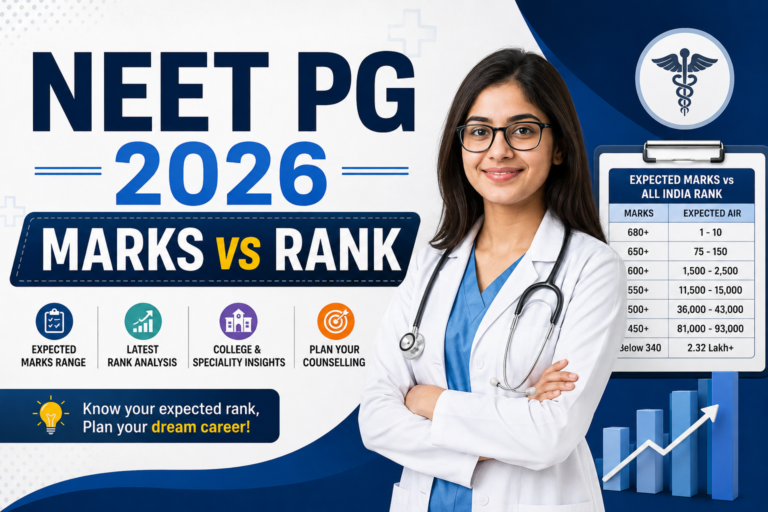
The answer key may be used to make an educated guess on your potential ranking but alone it cannot forecast results. Rank is based on overall examination performance, number of candidates, difficulty and more.
Final Words
Candidates can use NEET PG 2026 Answer Key to check their responses to the questions they could remember during the exam and assess their performance in the initial stages. This memory-based paper comprises important concepts from infectious diseases, pharmacology, anesthesia, dermatology, psychiatry, surgery, pediatrics, ophthalmology and nephrology that have been asked in the 20 questions.
Please note that this is a memory based answer key and should not be considered as an official result document. Final judgments of student performance should be rendered once the appropriate examination authority has provided the scores and results in relation to the relevant examination.